
Running an Article 50(4)-compatible review workflow in Locize
From August 2, 2026, Article 50 of the EU AI Act requires AI-generated content to be identifiable as such. Under the European Commission's final guidelines (July 20, 2026), faithful AI translations are exempt from the machine-readable marking duty, but AI-translated text that informs the public on matters of public interest still needs a visible disclosure under Article 50(4) — unless it has undergone substantive human review, with a named person holding editorial responsibility. The guidelines' own example of that exemption is an AI-supported translation of a human-written article whereby the translation has undergone human review. The legal background, the dates and the reversal from the draft guidelines are covered in the explainer Is machine-translated content "AI-generated" under the EU AI Act?. This page covers the practical side: how to run that review workflow in Locize and how to document it.
This is not legal advice. This page describes Locize features and a workflow setup for orientation. For decisions about your own obligations, consult a qualified lawyer.
Step 1: enable review proposals
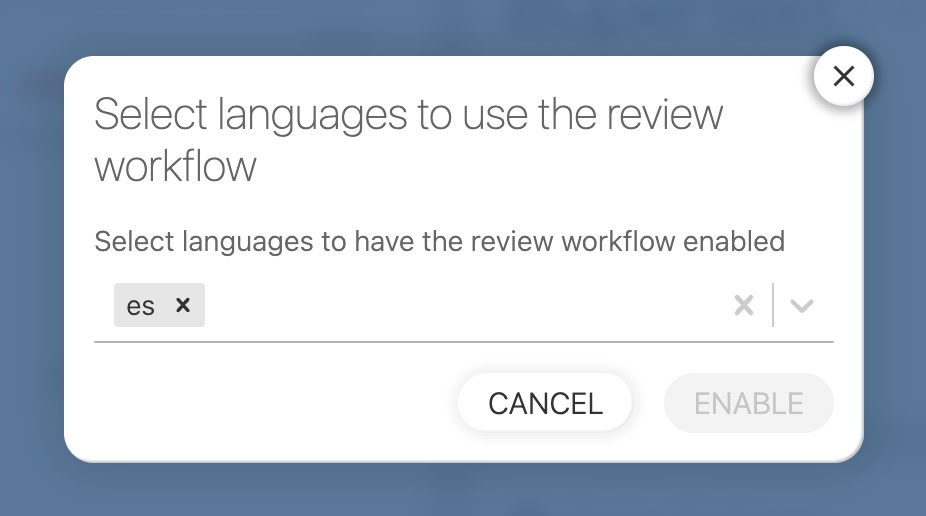
Enable review proposals for the languages where review matters to you. Once enabled, changes to translations become pending proposals instead of direct writes, and the actual value only changes when a reviewer accepts a proposal.
Project settings, EDITOR, TM/MT/AI, ORDERING tab, Review proposals row in the Translation Quality card.
Step 2: route low-confidence AI translations into review
With Quality Estimation enabled, every AI translation is scored with a confidence estimate between 0 and 1. The additional Review AI workflow setting routes low-confidence AI translations into review automatically, across all languages, even those without the regular review workflow enabled. High-confidence AI translations are saved directly, so your reviewers' substantive attention goes where the AI is least sure.
Routed proposals carry the confidence score, a critique (accuracy, fluency, terminology, style) and, where possible, a one-click suggested revision.
Step 3: review substantively, with the right roles
The exemption asks for deliberate examination of the substance by people with relevant competence, not a rubber-stamp click. In Locize:
- Give reviewers distinct roles and review permission via user management, scoped to the languages they are competent in.
- Reviewers accept, edit or decline each pending proposal in the editor. Every decision is recorded in the segment history: who decided, when, and for AI proposals the confidence score at the moment of the decision.
Two details from the final guidelines worth building into the process: fact-checking the content is named as a minimum ingredient of a qualifying review, and the review must be the last substantive touch — if AI modifies, supplements or reformulates the content after editorial sign-off, the exemption becomes void. In practice: re-running machine translation over already-reviewed segments restarts their review, so publish after review, not before.
Step 4: name editorial responsibility publicly
The second condition of Article 50(4) is that a natural or legal person holds editorial responsibility for the publication, publicly findable. This is not a Locize feature but part of the checklist: name that person or entity in your website's legal notice, terms or colophon.
Step 5: export the evidence (provenance export)
The provenance export packages the review evidence in one download, so "this went through human review" is something you can hand to an auditor.
Where: in the project overview, open the context menu of a version (all languages), a language or a single namespace and choose provenance (CSV + JSON). Available from the Growth plan, like review proposals (app v2.8.0 and later).
What you get: one ZIP containing the same report as CSV (opens directly in Excel) and JSON (for programmatic use). The file stands alone: a header records the project, version, languages, namespaces, who generated it and when, summary counts per review status, and the known limitations (see below). Each key row lists:
- the current value, its source (HT human, MT machine translation, AI) and its current confidence score
- the last action: review accepted, review declined, edited, delivered by a translation service, written or confirmed by an AI agent, or machine output with whoever triggered it, with who decided, who proposed, when, the value at that moment and the confidence score at decision time
- pending review proposals with proposer, date and confidence
- a
reviewStatusclassification
What reviewStatus means for an auditor:
| Value | Meaning |
|---|---|
pendingReview | Proposals are awaiting a decision. The current value is not yet the reviewed outcome |
humanReviewed | The last human action was a review decision (accept or decline) recorded with the reviewer's identity |
humanEdited | A human edited the value directly, or a translation service delivered it, outside a review decision |
apiConfirmed | The live value was confirmed over the API (CLI, pipeline or integration) by clearing its needs-review mark. The record carries the masked API key and whether the CLI was used, not a person: your pipeline knows what that confirm stands for |
agentEdited | The last action was a write made with a personal access token an AI agent uses (every token used through the Locize MCP server, including the ones its OAuth sign-in creates). The record names the agent and the token's owner. Not a human edit |
agentConfirmed | The needs-review mark was cleared with such an agent token. The record names the agent and the token's owner. Not a human review |
machineOnly | A machine or AI value with no human action after it: either nothing was recorded, or the last write was machine output (an auto-translation after a save, or the editor's machine-translate action), which the record shows with whoever triggered it |
noHistory | No recorded history for this key: typically a human-sourced value that was never changed, or history that has been trimmed (see limitations) |
Limitations
The export discloses its own limitations in the file header. Mirrored here:
- History is size-bounded. Per namespace, history shares a fixed budget (about 400KB) and is trimmed oldest-first. On very active namespaces, old review events can be trimmed away, and affected keys are reported as
noHistoryrather than guessed. - Machine output recorded before October 2026. Until then, the history did not keep the source of machine output written after a person's save (an auto-translation, the editor's machine-translate action). Such entries still read as
humanEdited; later writes are classified as described above. - Confidence scores on older decisions. Review decisions made before app v2.8.0 do not carry the confidence score on the decision itself. For those, the score is reported only while the accepted AI value is still unedited, in which case the current value's score is the at-acceptance score.
FAQ
Q. Does the provenance export make me compliant with the EU AI Act?
A. No tool makes you compliant, and Locize does not either. What the workflow and the export give you is the documented, substantive, person-attributable review process that the Article 50(4) exemption asks for. See the explainer for the legal background.
Q. Is there a formal way to demonstrate Article 50(4) compliance?
A. Deployers can adhere to the Commission's Code of Practice on transparency of AI-generated content, which the Commission and the AI Board assessed as adequate for exactly this purpose (July 8-9, 2026); the initial signatory list of July 31, 2026 counts 83 providers (including OpenAI, Google, Mistral and Anthropic) and 152 deployers. Adherence is voluntary — not signing implies nothing about compliance — and either way the review workflow and provenance export on this page are the evidence that the human-review condition was actually met.
Q. Who can download the export?
A. Project members with management permissions, on plans that include review proposals (Growth and above). The export only covers languages and namespaces the downloading user is authorized to read.
Q. Do I need review proposals for every language?
A. No. The Review AI workflow routes low-confidence AI translations into review selectively, across all languages. Enable review proposals for the languages where everything should be held for a decision, and let confidence-based routing cover the rest.
Q. Is the export generated on Locize servers?
A. It is assembled in your browser from the project data your user is authorized to read, and downloaded directly. Nothing is published or stored elsewhere.
If you want your translation workflow on this footing: create a free Locize account, enable review proposals and Quality Estimation for your languages.