EU Accessibility Act: multilingual compliance for digital products.
The EU Accessibility Act (Directive (EU) 2019/882) requires digital products and services placed on the EU market to be accessible to people with disabilities. Enforcement started 28 June 2025. Most SaaS, e-commerce, banking, telephony, transport, and audiovisual media companies serving EU users are in scope.
The EAA itself focuses on accessibility, but it intersects with EU language rules. Cross-border digital products typically need to deliver content in the official languages of the EU markets they serve, and they need to update that content fast when compliance issues are flagged.
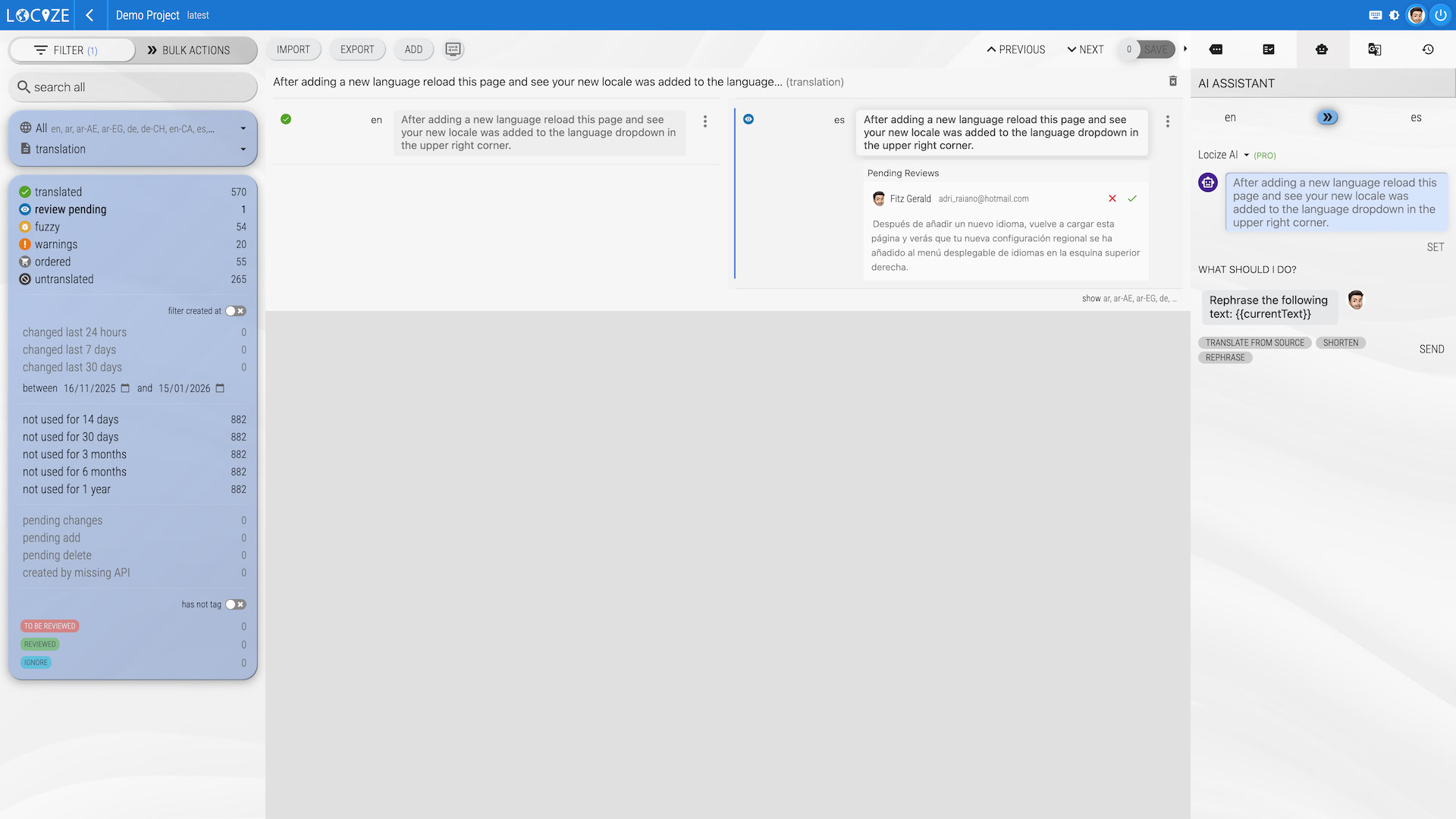
Locize handles the multilingual side: CDN-delivered translations (no redeploys for compliance fixes), review workflow for legal sign-off, per-key audit log for compliance audits, glossary and style guide for terminology consistency, AI translation with human review for fast coverage of additional EU languages.
What changed on 28 June 2025
Directive (EU) 2019/882 came into enforcement after a 6-year transition period. Penalties are now active.
- E-commerce websites and apps
- Banking and financial services (consumer-facing)
- Telephony: voice + smartphone manufacturers
- E-readers, e-books, and audiovisual media services
- Transport: passenger transport info, ticket machines
- Computers, smartphones, and ticketing systems
- Self-service terminals (ATMs, ticket vending)
Any business (inside or outside the EU) placing covered products or services on the EU market. The microenterprise exemption (fewer than 10 employees AND under €2M annual turnover) only applies to the service requirements, not the product requirements.
Most SaaS, e-commerce, fintech, and digital media companies serving EU users are in scope. National regulators (France's ARCOM, Germany's BFIT-Bund, Italy's AgID, etc.) have begun issuing compliance notices.
Each EU member state defines its own enforcement. Penalties typically include: fines proportional to company turnover, removal of non-compliant products from the EU market, and mandatory remediation plans. Reputational risk is significant; enforcement notices are typically public.
Where multilingual content fits into EAA compliance
The EAA focuses on accessibility (alt text, captions, keyboard navigation, screen-reader compatibility), but it doesn't exist in isolation.
Accessibility is content-in-the-user's-language as a precondition. A screen reader cannot make English copy accessible to a Polish user; captions in a foreign language aren't accessibility.
Multiple overlapping EU rules already require local-language content:
- Consumer Rights Directive (2011/83/EU): consumer info in the member-state language
- Web Accessibility Directive (2016/2102): public-sector bodies, parallel scope
- National implementations: France's Toubon Law, Belgium's regional rules, Italy's Stanca Act
If you operate cross-border in the EU, you typically need to deliver your product in the official languages of the markets you serve, plus alternative text, captions, and accessibility statements in those same languages.
When a compliance issue is identified (by a regulator, a customer complaint, or an internal audit), fixes need to ship fast. That's where translation-by-redeployment becomes painful: a typo in an accessibility statement should not require a release.
Multilingual compliance checklist
Practical questions to answer about the multilingual side of your EAA programme.
- Which EU markets do you serve? Map the official languages of each. As a floor, English is rarely sufficient by itself for consumer-facing services.
- Is your accessibility statement available in each market language? The statement itself is required under multiple EU rules, and must be in the language of the user.
- Can you ship a translation correction without a deployment? If a regulator flags a translation issue, you should be able to fix it in minutes, not in a release cycle.
- Do you have a documented review workflow for translations? Auditors will ask who signed off on the localised copy and when. Per-key audit log is the standard answer.
- Are alt text, captions, error messages, and form labels translated? These are easy to miss when localising marketing pages but not product chrome.
- Is terminology consistent across all languages? "Accept" / "Agree" / "Continue" inconsistencies can break the accessibility flow for screen-reader users moving across pages. A project glossary is the cleanest way to enforce this.
- Can you add a language quickly if a new market becomes a priority? Manual translation programmes typically take weeks; AI translation with human review can be days.
This is a multilingual-content checklist. Accessibility itself also requires WCAG 2.2 AA compliance, EN 301 549 conformance, and product-specific requirements; consult an accessibility specialist for the full picture.
How Locize maps to EAA-driven multilingual needs
Each Locize feature ties directly back to a multilingual-compliance need.
| Compliance need | Locize feature |
|---|---|
| Ship a translation correction in minutes | CDN-delivered translations: edits go live without a redeploy |
| Legal / accessibility sign-off on translated copy | Review workflow: accept/decline with diff visualisation, per-language reviewers |
| Audit trail of who changed what, when | Per-key history + audit log on higher plans |
| Consistent terminology across all languages | Project glossary + style guide injected into AI prompts |
| Add a new EU language quickly | Automatic Translation with BYOK (OpenAI, Gemini, Mistral, DeepL) + human review |
| Multi-tenant overrides (regional brands, white-label) | Multi-tenant: per-tenant override layer over a shared base |
| EU/CH data residency for translation data | Operated by a Swiss-registered company with translation data hosted in AWS Ireland; see our security page |
Teams already shipping multilingual EU products with Locize

Thanks to the generous support and the features of Locize, the headless websites of the Swiss Red Cross can be translated into different languages within a short time!

We're using Locize for several projects, which offers different services for our international partners in the whole world.
Thanks to Locize our localization workflow is faster, more efficient and modern.
With the introduction of Locize, we had an overview of the status of translations or which text content still needed to be translated from the very beginning.
Thanks to the very flexible API, the current texts are integrated in every build (for technical reasons, ZKB cannot use an external CDN).
The handling is self-explanatory for translators.
Locize also has excellent support and very reasonable conditions.
Being a Swiss Startup, we had to launch our website in several languages at once. We used i18next with React and were translating JSON files by hand, which was really cumbersome.
Locize really changed everything for us because it allowed us to let non-developers translate the website pages.
Decouple the translation process from application deployments.
Use Google Translate straight from within the tool. Really recommended.
Frequently asked questions
If your question is missing, email support@locize.com
The EU Accessibility Act (EAA, Directive (EU) 2019/882) is a 2019 EU directive requiring digital products and services placed on the EU market to be accessible to people with disabilities. Enforcement began 28 June 2025. Covered products include e-commerce, banking, transport, telephony, e-readers, audiovisual media services, computers, smartphones, and ticketing systems. Non-compliance leads to member-state-defined penalties, typically fines.
The EAA itself focuses on accessibility (alt text, captions, keyboard navigation, etc.), not language. But it interlocks with other EU rules: the Web Accessibility Directive for public-sector bodies, the EU Consumer Rights Directive requiring consumer info in the member-state language, and national implementations that often add linguistic obligations. In practice, SaaS or e-commerce companies serving multiple EU markets need multilingual content alongside strict accessibility requirements.
Any business (inside or outside the EU) placing covered products or services on the EU market. Microenterprises providing services (fewer than 10 employees AND under €2M annual turnover) are exempt from the service requirements, but not the product requirements. Most SaaS, e-commerce, fintech, and digital-media companies serving EU users fall in scope.
Locize covers the multilingual side: CDN-delivered translations so compliance fixes go live without redeployment, review workflow for sign-off by legal / accessibility experts, per-key audit log for compliance audits, glossary and style guide for terminology consistency, and AI translation with human review for fast coverage of additional EU languages.
There are 24 official EU languages. The exact requirement depends on which markets you serve and which national language laws apply. As a floor, most cross-border SaaS providers target the languages of the markets they actively sell into — typically a subset of: German, French, Spanish, Italian, Dutch, Polish, Portuguese, Swedish, plus English as a fallback. National regulators (e.g. France, Belgium, Quebec-influenced Wallonia) strictly enforce local language requirements.
Member states define their own enforcement. Penalties typically include fines (proportional to company turnover), removal of non-compliant products from the market, and reputational damage. National regulators began issuing notices in late 2025. For service providers (vs. product manufacturers) there is additional grace period until 2030 in some scenarios, but the core enforcement started 28 June 2025.
This page describes the multilingual-content side of EAA compliance. Accessibility itself (alt text, captions, keyboard navigation, WCAG/EN 301 549 conformance) requires specialist tooling and audits; consult an accessibility expert for a full compliance programme.