
Multi-tenant Localization

Give each of your customers their own translation layer — without managing separate projects or duplicating content.

The problem

You have a multilingual SaaS product, and each of your customers wants their own language customizations — branded terminology, region-specific phrasing, or entirely different translations for certain strings.

Without multi-tenant support, you end up duplicating entire projects, writing custom override logic, or abusing namespaces and locale codes to simulate per-customer content. None of these approaches scale.

Common workarounds that break down
Duplicating the full project per customer
Using extra namespaces like "customer1_common"
Custom locale codes like "en-x-customer1"
Manual merge scripts between projects

How Locize solves it

A parent project holds your base translations. Each tenant project inherits everything and overrides only what they need.

01

Parent project

Your main project contains the base translations for all languages. This is the single source of truth.

02

Tenant projects

Each customer gets a child project that inherits all translations from the parent. Only overridden strings are stored separately.

03

CDN delivery

Each tenant has its own CDN endpoint. The runtime merges parent and tenant translations automatically.
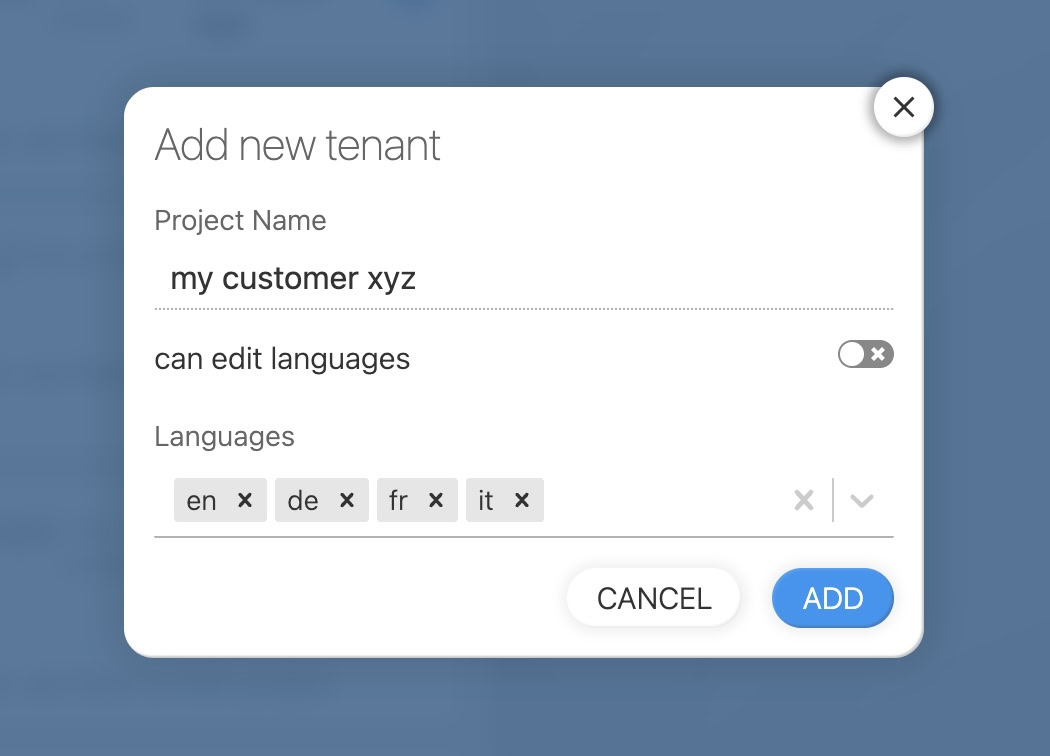
Add a new tenant project in Locize

Key capabilities

Everything you need to manage per-customer translations at scale.

account_tree
Parent/child inheritance
Tenant projects inherit all translations from the parent. New keys added to the parent appear in every tenant automatically.
edit
Namespace-level overrides
Tenants override individual strings while the rest fall through to the parent. Only overridden values count toward the tenant's usage.
language
Language sync options
Choose per tenant: sync languages with the parent project automatically, or let each tenant manage their own language set independently.
lock
Isolated access control
Tenant users see only their own project. Customers cannot access each other's data or the parent project.
payments
Flexible billing
Cover costs yourself or let each customer pay for their own tenant usage. Pricing is based on overridden values only.
security
Permission inheritance
Roles and permissions flow from parent to child projects. Enforce MFA and access restrictions consistently across all tenants.

Who it's for

SaaS companies
Let each enterprise customer customize product language without forking your translation setup.
White-label product builders
Deliver a fully branded language experience per client with minimal operational overhead.
Agencies managing multiple clients
Maintain a shared base translation set and let each client project inherit and override as needed.
Franchise and multi-brand businesses
Each brand or region gets their own translation layer on top of a shared corporate base.

Ready to set up multi-tenant localization?

Read the full multi-tenant documentation or start a free trial to see it in action.