
10 years of Locize
Ten years.
Around this time in 2016 we launched locize.com. At the time it was a small backend for i18next that did one thing: ship translations to running apps without a redeploy. Today it still does that, and quite a bit more.
Where we started
The story properly begins five years earlier, in 2011. We needed an i18n library that worked on both Node.js and in the browser, and nothing on offer fit cleanly. So i18next was written. It grew faster than we expected. A community formed around it, plugins appeared for every framework that mattered, and we kept refining the core.
That was the easy part.
The hard part turned out to be everything around the runtime: how translations actually get written, reviewed, versioned, delivered, edited in place, queued for AI/MT assistance, audited, exported, re-imported, kept in sync with code. The library could only do so much. The workflow was its own animal.
By 2016 we had been on the receiving end of that workflow problem for long enough that we knew what we wanted. Continuous localization. CDN-delivered translation. A real editor for translators. saveMissing so developers never have to copy strings into a spreadsheet again. An in-context editor that opens on top of the running app, so a translator can click a phrase and edit it where it lives. That became Locize.
There's an earlier post on this blog from those first weeks if you want the original framing: Day zero, how all began.
What we built
Ten years on, the product is bigger than its first sketch, but the spine is the same.
- Translation management with the workflows real teams need (versions, history, permissions, segments, statuses).
- A CDN that serves published translations globally on both Standard (BunnyCDN) and Pro (AWS CloudFront) infrastructures.
- Native support for a long list of i18n formats, not just i18next JSON.
- AI translation that runs against your reference language, your terminology, and your context. Not a sidecar, a first-class workflow.
- An in-context editor that lives in the
locizepackage and now plugs into vue-i18n alongside i18next. - A growing set of framework recipes: Next.js, React Router v7, Nuxt 4, Astro, and the older guides for React, Vue, Remix, and the rest.
- Swiss-made, GDPR-clean by default.
Behind all of that, the deeper thing: a workflow where developers ship code and translators ship translations and neither side blocks the other. That was the goal in 2016 and it still is.
What it actually feels like
Running a small SaaS for ten years is not a straight line.
Some weeks you ship a major release and a customer writes in to say it made their week. Other weeks you spend three days chasing a hydration bug that turned out to be a single missing capital N in a class name (true story, fixed in locize@4.0.24). Some quarters churn drops on its own and you don't know why. Some quarters you ship the cleanest feature of the year and the metrics don't move.
The laptop doesn't stay home on vacation. The phone is always within reach. You're always one step ahead of something, and one step behind something else.
In return you get an unreasonable amount of flexibility. You decide what to build, when to build it, and which trade-offs to accept. You answer to the customers, the code, and the people you work with, and not much else. For us that trade has been worth it for ten years running.
A cake from home
A small story to close.
To mark the anniversary, a co-founder's wife (who writes the food blog frangipani.food) baked a pistachio cake filled with mascarpone-and-elderflower chantilly. The recipe is on her side in German and Italian if you want to make it yourself. The elderflower has to sit in cream for 24 hours before you whip it with mascarpone, but the floral note that comes through afterwards is worth the planning.
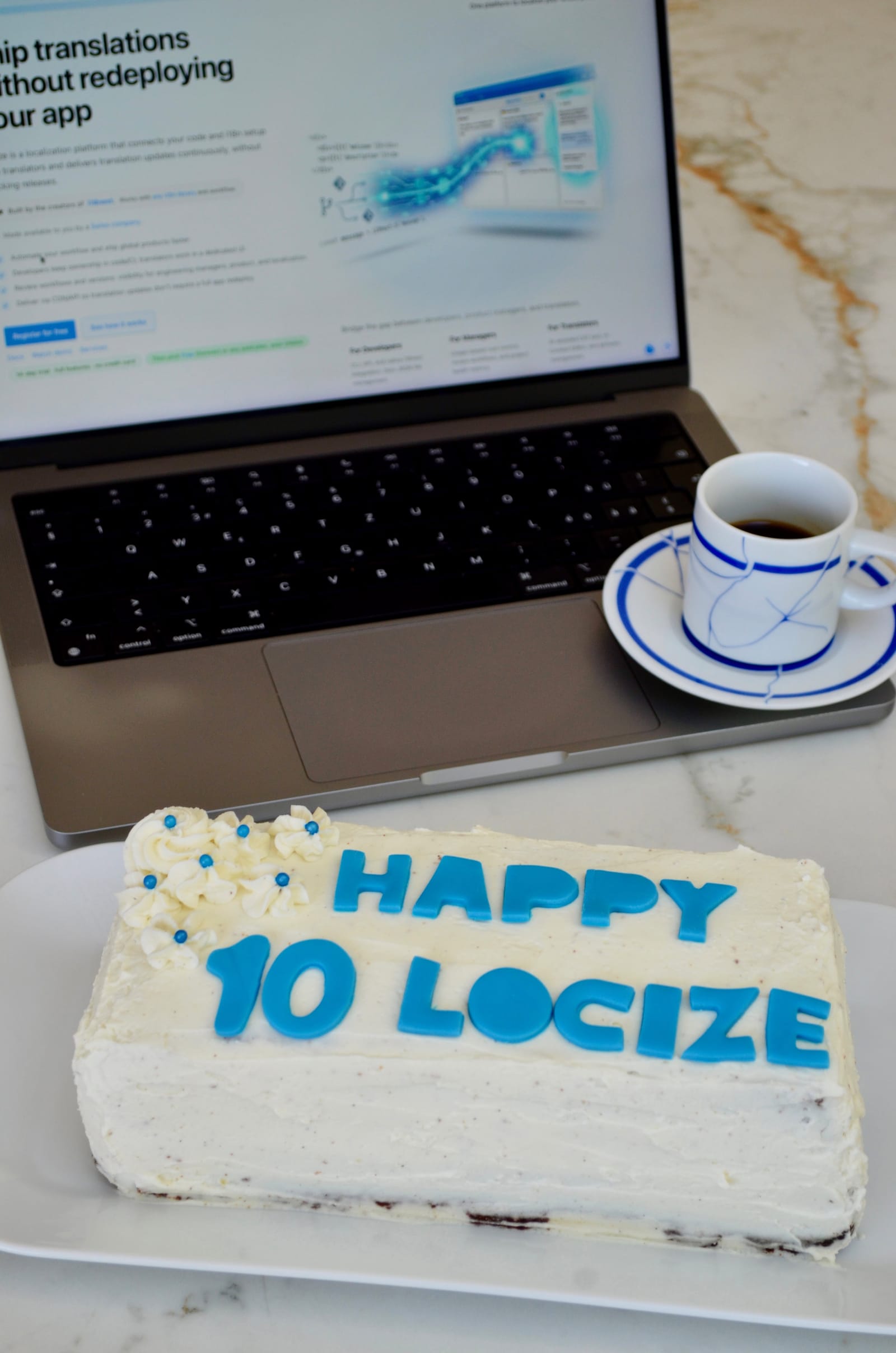
She also wrote a few lines on her side about what it's like to live with someone who runs a small business: the laptop that travels everywhere, the phone that doesn't stop, the freedom that comes with it anyway. Worth a read on the original post.
Ten years like these aren't built by founders alone. The families who put up with the laptops and the late nights. The team. The i18next community. The customers who stuck with us through every iteration. The open-source maintainers who built the ecosystem Locize sits on top of. All of you.
Looking ahead
There is no roadmap reveal in this post. The next ten years will go where they go. AI keeps rewriting the contract between what software and people each do, the JavaScript framework wars keep reshuffling, and i18next-shaped problems will keep showing up in places we don't expect. We will keep meeting them where they land.
If you've been using Locize for any stretch of that decade, thank you. If you're reading this for the first time, welcome.
Same workflow. Same Swiss-made platform. Same co-founders. Ten more years to go.
— The Locize team