
What Is Translation? Types, Modern Workflow & Quality
Translation is the process of conveying text or spoken content from one language into another while preserving meaning, tone, intent, and cultural context. It is more than word-for-word substitution: an effective translation reads naturally to its target audience and adapts idioms, formality, and cultural references that do not carry across languages directly. In modern workflows, translation is increasingly produced by a combination of machine translation (for speed and scale) and human translators (for nuance and quality), a hybrid approach known as post-editing.
- What it is: converting text or speech between languages while preserving meaning, tone, and intent
- Main types: specialist, business, legal, medical, marketing, technical, literary, e-commerce, localization
- Core tools: CAT tools, translation memory, glossaries, style guides, translation management systems (TMS)
- Modern workflow: machine translation + human post-editing
- Beyond translation: localization adapts the whole experience (formats, currency, layout, cultural references); translation is one part of localization
Translation should be seen as an integral part of a comprehensive localization strategy, not an isolated step.
Why translations matter for international companies
For global companies, localization translation is essential to overcome language barriers and reach customers in their own language. Professional translations build customer trust and market acceptance; inaccurate translations can damage reputation and cause costly misunderstandings.
Through professional translations, companies present their products, services, and brand messages clearly across languages. A good translation also takes regional characteristics and cultural nuances into account, increasing credibility in each target market.
In areas such as marketing, legal documents, and technical manuals, accurate and culturally appropriate translation is essential, both to avoid errors and to protect the international image of the company.
What are the different types of localization translation?
There are different types of translation, each tailored to specific needs and content. These include the following:
Specialist translation
Specialist translations are specialized in certain subject areas such as medicine, law, technology or business. They require a deep understanding of the specialist language and terminology to ensure accurate and error-free translations.
Business translation
The term business translation covers the transfer of content between two languages that supports international business activities. This includes various documents, marketing materials and digital resources.
Document translation
Document translation involves the creation of business translations, business correspondence, internal communications, manuals, contracts, technical specifications and other important documents. The challenges here often lie in the large volume and fragmented structure of the documents, as well as the need to maintain consistent terminology throughout the text.
Literary translation
This is the translation of books, poems and other literary works. The aim is to preserve not only the meaning, but also the style, tone and cultural nuances of the original.
Legal translation
Whether contracts, deeds, patents or other legal documents, legal translations place high demands on the translator. As these are binding, they must be accurate and comply with the legal standards of both countries. Translations of court and legal documentation are another sub-category of this specialty area.
Arrest warrants, registrations, certificates, declarations, affidavits, patents, trademarks, proceedings, lawsuits, decrees, contracts and insurance policies are just a few examples of legal documents that need to be translated.
Marketing and advertisement translation
Marketing and advertisement translation often requires a creative translation that adapts the message to the cultural and emotional expectations of the target audience. The translation should achieve the same feeling and effect as the original.
Learn more in our guide on localization marketing.
Medical translation
Medical translation is subject to strict requirements and includes clinical trial protocols, patient information, regulatory documents and other critical texts. Due to the potentially vital consequences, this type of translation requires specialized expertise, the utmost precision and special attention to detail.
E-commerce translation
In global e-commerce, multilingualism is important to appeal to customers in different markets. Landing pages, product descriptions, customer reviews and blog articles must be translated into the respective target market language. It is important to find a balance between precision and SEO optimization and to take cultural nuances into account.
Technical translation
This includes translations of technical documents such as manuals, instructions and technical specifications. Accurate, clear and comprehensible terminology is particularly important here to ensure that products are used correctly.
Localization translation
Localization involves the comprehensive adaptation of a product or service to the cultural and linguistic conditions of a target market. This form of translation is often used for software, websites or games and takes regional characteristics into account.
What factors play a role in localization translation?
Let's take a closer look at localization translation and take a closer look at this type of translation. Several important factors are required to ensure that the content is not only linguistically but also culturally adapted to the target market.
- Localization translation goes beyond mere translation and takes into account cultural characteristics such as regional holidays, country-specific symbols, colors and images, which can have different meanings depending on the culture.
- The language is adapted to local dialects, language variants and idioms in order to sound authentic and understandable. This is particularly important in order to address the target group at eye level and create a personal connection.
- Content must be adapted to the legal requirements of the target market, especially for legal documents, product descriptions and data protection guidelines, to ensure compliance.
- Information such as currencies, units of measurement (e.g. inches instead of centimeters) and date formats (e.g. day, month, year) need to be converted to avoid misunderstandings and create a familiar user experience.
- The tone and style of the translation should be adapted to the expectations of the target audience. For example, a more formal approach may be preferred in some countries, while other markets may expect more casual, informal language.
- For software and websites, technical adaptations play a role, such as supporting different characters, text lengths and layout changes to ensure the application displays correctly on all devices and platforms in the target market.
- For digital content, it is important to adapt keywords to local search terms in order to remain visible in search engines. Localization therefore also includes optimization for the respective language and region.
- Images, symbols and graphics should be adapted to cultural expectations. An image that evokes positive associations in one region could be interpreted differently or even be perceived as inappropriate in another region.
How can translations be implemented?
Localization translations can be implemented through a combination of strategies and technologies that together ensure that the content is translated into the target languages in an accurate and culturally appropriate way.
The first step is to find and select professional translators or specialized translation agencies who have the necessary expertise and understanding of the target culture. The experts then produce an initial translation.
To increase efficiency, modern translation tools such as translation management systems are usually used, which store previously translated segments and reuse them as required.
This maintains consistency and speeds up the translation process considerably. Other core tools include CAT tools (computer-aided translation), which help translators to translate content even more accurately through automation.
Key functions of CAT tools include:
- Translation memory: saves previously translated segments and reuses them automatically, saving time and keeping wording consistent across projects.
- Glossaries: enforce specific terms (product names, technical vocabulary, legal terms) so translators do not paraphrase them differently each time.
- Style guides: capture tone, brand voice, and formatting rules, what your reviewers would otherwise have to teach every new translator from scratch.
- Quality assurance: automated checks detect typos, missing placeholders, inconsistent terminology, and segment-length issues before review.
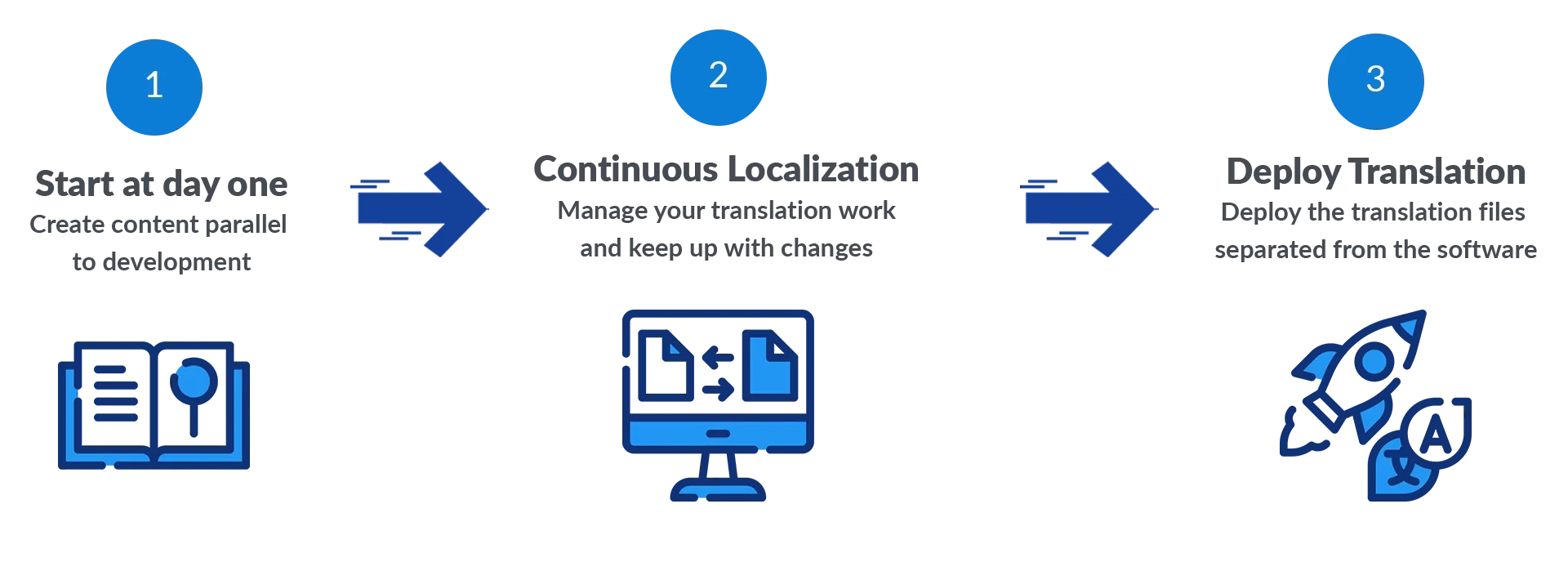
A translation management system (TMS) extends these functions even further and usually includes additional project and workflow management. It therefore facilitates the coordination of complex projects and can be linked to CMS, CRM or e-commerce platforms. In this way, TMS platforms support companies in efficiently integrating their translations into existing business processes and ensuring the quality of international communication.
However, experienced localization experts or specialized tools are essential for localization, i.e. adapting to cultural peculiarities. They not only translate, but also adapt the content to the cultural and legal requirements of the target market.
Speech-to-text and live translation are now mainstream in collaboration tools: Microsoft Teams, Zoom, and Google Meet all offer real-time captioning and translation. For written content, the bottleneck has shifted from "can a machine translate?" to "is the output accurate, consistent, and on-brand?", which is where TMS, glossaries, and style guides earn their keep.
Machine translation vs. human translation: which is better?
Machine translation and human translation each have their strengths and are suitable for different requirements. The choice between the two depends heavily on factors such as quality, speed, cost and the required understanding of cultural nuances.
Machine translation is useful when large volumes of text need to be translated quickly and rough comprehensibility is sufficient. Modern machine translations, supported by artificial intelligence, offer high speed and are often more cost-effective than human translations. They are well suited to simple or standardized texts, such as simple manuals or internal documents, where the risk of misunderstandings is low. However, machines often reach their limits with creative, emotional or culturally sensitive texts. Nuances, wordplay or contextual subtleties are difficult or even impossible to translate correctly.
Human translation, on the other hand, is particularly superior for demanding, creative or culturally complex texts. Professional translators have a deep understanding of the subtleties and cultural context of a language, which is crucial for high-quality, authentic and emotionally appealing translations. This enables them to accurately convey not only the meaning, but also the intention and style of the original. For marketing materials, literary texts and legal documents, these differences are simply indispensable.
In many cases, however, a combination of the two is also useful: machine translations can be created as a first version and then checked and adapted by human translators. This approach, known as "post-editing", utilizes the speed of the machine while ensuring quality through human sensitivity. For more depth, see How AI Translation Changes the Industry and Machine Translation, Translation Memory, Generative AI, and More.
Frequently Asked Questions
Translation is the process of conveying text or spoken content from one language into another while preserving the original meaning, tone, intent, and cultural context. It goes beyond word-for-word substitution: a good translation reads naturally to its target audience and adapts idioms, formality, and cultural references that do not carry across languages directly.
Translation converts the text. Localization adapts the entire experience for a target market: text plus date and number formats, currency, address layouts, plurals, gendered language, images, and sometimes layout direction (RTL for Arabic and Hebrew). Translation is one part of localization; localization is what makes a product feel native rather than translated.
The most common categories are specialist (medicine, law, engineering), business and document, literary, legal, marketing and advertising, medical, e-commerce, technical, and localization translation. Each type has its own quality requirements, terminology, and review process. For example, legal translation requires legal validity in both jurisdictions, while marketing translation often crosses into transcreation (creative adaptation).
Machine translation (MT) is automatic translation produced by software, today almost always using neural machine translation (NMT) or large language models. Tools like Google Translate, DeepL, and OpenAI/Anthropic models can translate large volumes of text in seconds. MT is reliable for general comprehension on major language pairs but typically requires human post-editing for customer-facing or specialized content.
Post-editing is the process of a human translator reviewing and refining machine-translated output. It is faster than translating from scratch and produces higher quality than raw MT, making it the standard workflow for most professional translation today, especially in software localization, e-commerce, and technical documentation.
CAT (computer-aided translation) tools are software that help human translators work faster and more consistently. Core features include translation memory (storing previously translated segments for reuse), glossaries (enforcing terminology), style guides (capturing tone and brand voice), and quality-assurance checks. Modern translation management systems (TMS) like Locize bundle CAT features with workflow, review, and delivery (CDN/API).
A typical modern workflow combines machine translation, translation memory, and human review. Source text is pre-translated by an MT or AI engine, segments matching the translation memory are reused, and a human translator post-edits the result against a project glossary and style guide. The finished translation is reviewed, approved, and delivered to the target system, often a website, app, or product through an API or CDN.
Conclusion
Translation is a deceptively complex craft. The mechanics of converting words between languages have largely been solved by neural machine translation, but the quality bar (preserving meaning, tone, intent, and cultural fit) still requires human judgment, a project glossary, a style guide, and a translation memory that learns from every previous decision. The teams that get this right treat translation as part of their product workflow, not as a one-off task they outsource at the end.
If you are localizing a software product, Locize is a translation management system designed around this hybrid workflow: AI/MT for speed, CAT for the editor, glossary and style guide for consistency, and human review for the final mile.