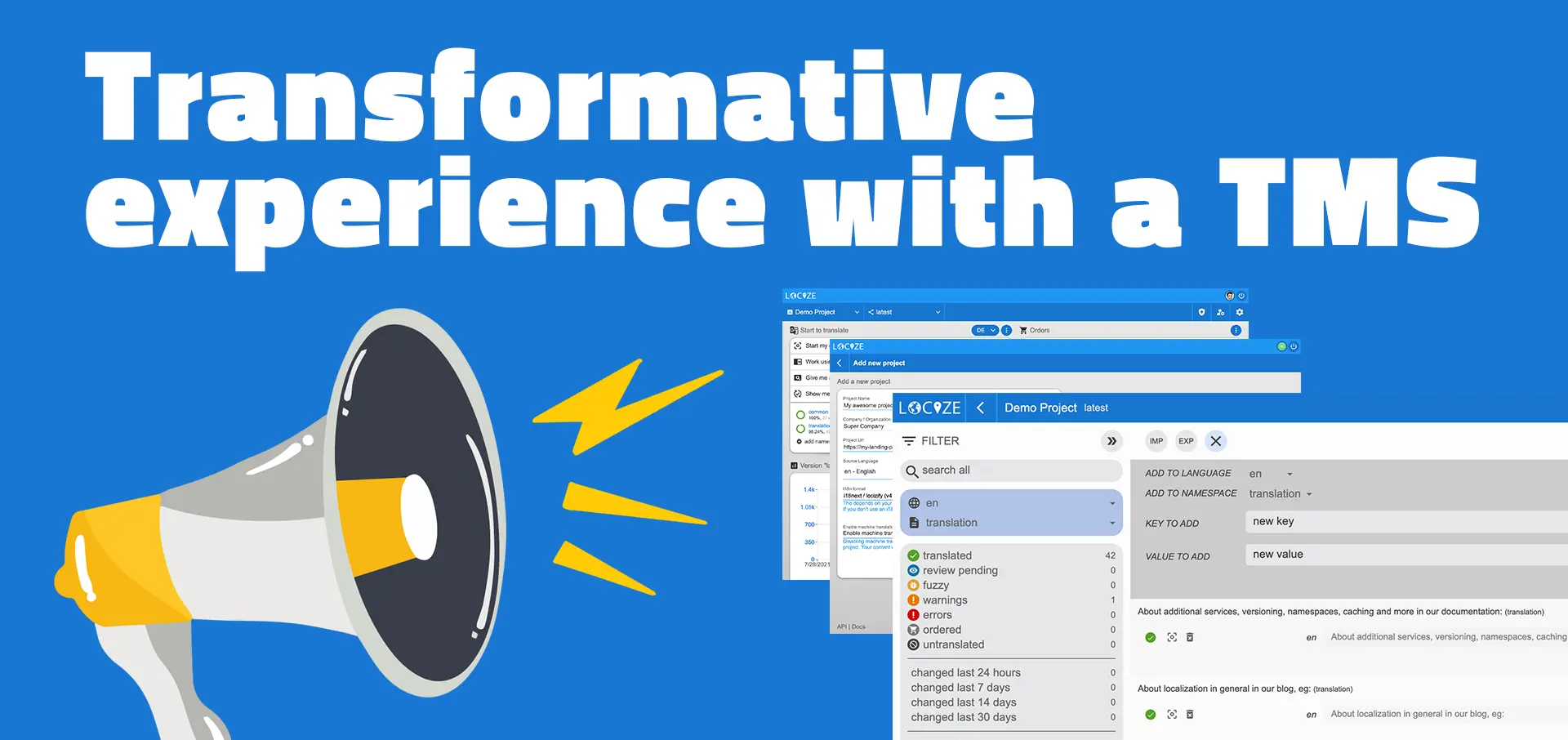
What is a Translation Management System (TMS)?
A Translation Management System (TMS) is software that centralizes the work of translating and localizing content: managing files, terminology, translation memory, automation, and integrations with developer tooling. It replaces ad-hoc spreadsheets and email-based handoffs with a continuous, repeatable workflow. A modern TMS handles assignment to translators, tracks progress, enforces glossaries and style guides, reuses previously translated content, integrates with CI/CD and CMS systems, and delivers translations to production via CDN or API. For teams localizing into more than two or three languages, or shipping product updates frequently, a TMS is the difference between localization that keeps pace and localization that is permanently behind.
- What it is: software that centralizes translation work: files, workflow, memory, terminology, delivery
- Core functions: workflow management, translation memory, glossary / style guide, reporting, AI / MT, integrations (API, CDN, Git, CMS)
- vs CAT tool: CAT = single translator editor; TMS = team workflow + integrations + delivery (modern TMS bundles a CAT view)
- Translation memory: database of past source / target pairs, reused for new content via fuzzy and exact matching
- When you need one: 2-3+ languages, multiple translators, frequent product updates, or developer-tool integration requirements
- What to compare: i18n-format support, pricing model (per-seat / per-word / usage-based), delivery (CDN/API), workflow flexibility, data ownership
In order to handle translations and make things simpler for translators, a TMS automates non-essential activities and offers useful features. Learn how to use a TMS as an integral tool for a truly transformative experience in your business, and understand how development cycles accelerate and software quality grows to new heights.
Table of contents
- What functions does a Translation Management System require?
- Benefits of using a TMS
- How translation management helped businesses scale
- What to consider while comparing various software solutions
- Why project managers and developers choose Locize as their TMS
- Transformative experience with continuous integration
What functions does a Translation Management System require?
A TMS is designed to manage translation and localization tasks centrally and continuously. While implementations differ, a modern translation management system should cover the following core functions.
Managing translation workflows
- Define what to translate
- Send files to translators
- Track translation progress
- Review and approve changes
- Deliver translations back to production
A TMS reduces the amount of manual effort performed during each of these steps. Otherwise, it can be difficult for managers, translators, and reviewers to coordinate and promptly execute crucial project specifics, which frequently results in a longer time to market.
A good TMS will trigger a review procedure each time a translation is modified. Until one of the translation suggestions is accepted, the actual value won't change.
Managing terminology
Terminology is the fundamental cornerstone of all translations. To describe objects and form sentences, people use words, phrases, and jargon.
If your content generation is extended, certain criteria for managing material should be established for all parties involved.
You should keep track of terms that should or shouldn't be translated via a glossary. It exists to facilitate use of the language your business prefers by human translators.
Use the translation memory (TM)
A TMS's translation memory feature is especially crucial since it greatly boosts the productivity of language localization.
You can reuse words and phrases from previous work rather than coming up with new language every time. To assist human translators, sentences that have already been translated are stored in a database called a translation memory (TM).
History, reporting, and metrics
Every project management tool must provide the most crucial indicators about budget, progress, and other factors.
The majority of the tasks are contained in one program by the TMS. As a result, reporting the numbers is a must. The data insights from the TMS help improve the administration of your localization projects.
Additionally, keeping track of all previous translations is helpful. In the event of an inconvenience, it is possible to demonstrate at any moment who made what changes and when.
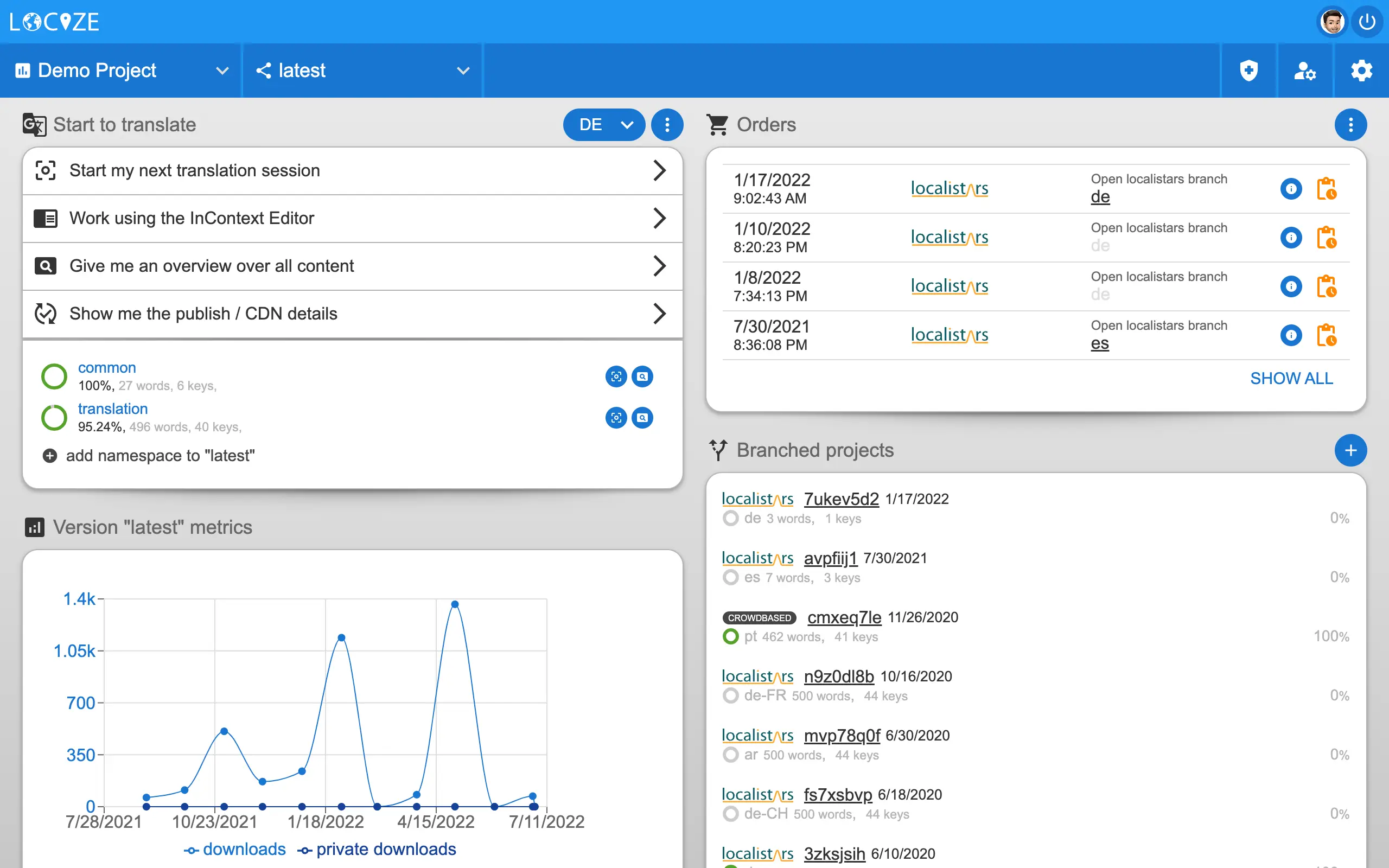
Locize, our translation management system, offers an overview of the control center with the key figures for the ongoing project.
The control center of our localization software displays all pertinent high-level data:
- user management
- billing (customer details, billing history, budget limit, ...)
- project settings (Slack integration, webhook, integration metrics, ...)
- ordering (services, pending orders)
- branches
- project health and metrics
Auto machine translation
With this capability, the TMS attempts to automate parts of the translation process. Traditionally, an API is used to connect translated texts to an engine that handles the translation automatically.
Because results from artificial intelligence are typically not 100% polished, a translator is frequently needed to evaluate the auto translation output.
Read more in the AI in Localization article.
For Locize, the entire automatic machine translation process occurs in the backend, which means you'll see the translated result after saving new keys in the reference language.
Integration API
API technology is used by excellent TMS solutions to connect to and interact with cloud-based services. This enables it to automate and expand translation management in any content management system for all content kinds.
There is thorough documentation for Locize on how to utilize an API to integrate any of your applications:
Benefits of using a TMS
A TMS becomes essential when spreadsheets and manual processes no longer scale.
Key benefits include:
- Centralized control over translations
- Faster release cycles
- Consistent terminology and tone
- Reduced administrative overhead
- Better collaboration between developers and translators
- Scalable localization across products and markets
While a TMS may seem like an investment at first, it typically pays for itself by reducing delays, rework, and operational friction.
How translation management helped businesses scale
Organizations that adopt a TMS typically see improvements in:
- Productivity: Automation reduces manual coordination
- Quality: Consistent terminology and reuse of translations
- Scalability: Handling more languages and projects without linear cost increases
- Global reach: Faster entry into international markets
Rather than isolated translation projects, localization becomes a continuous, repeatable process.
Typical outcomes observed after adopting a TMS
While results vary by organization, the following scenarios reflect common patterns seen when companies move from manual translation processes to a centralized TMS.
More projects with the same team
Organizations that previously managed translations manually often face long turnaround times and heavy coordination effort. After introducing a TMS and automating workflows, project durations can shrink from weeks to days.
In a typical scenario, this allows teams to complete significantly more translation projects without increasing headcount, freeing up skilled employees to focus on higher-value work.
Lower operational costs
Manual project management is resource-intensive. By centralizing workflows, automating assignments, and reusing translations through translation memory, a TMS reduces administrative effort.
Many organizations report noticeable cost reductions in project coordination, which can then be reinvested into product development, market expansion, or quality improvements.
Revenue growth through scalability
As demand increases, companies without a TMS often struggle to keep pace. A scalable translation management system enables teams to take on additional projects and languages without proportional increases in effort.
This operational scalability frequently translates into revenue growth, as organizations can confidently accept more work while maintaining efficiency.
Higher quality and recurring business
Consistency is critical to client satisfaction. By enforcing terminology and reusing validated translations, a TMS helps ensure reliable quality across all projects.
Improved consistency and quality often lead to stronger customer retention and more recurring business, as clients trust the results they receive over time.
Expansion into global markets
For companies initially focused on a domestic audience, a TMS lowers the barrier to entering new regions. By managing multiple languages efficiently, organizations can reach international users faster and more reliably.
This capability often results in increased revenue from global markets, as products and content become accessible to a wider audience.
What to consider while comparing various software solutions
When you compare different translation management software, ask the following questions regarding your business:
- Who will be impacted and how quickly (stakeholders, customers, employees)?
- How will the TMS improve the end-user experience?
- How much are we willing to spend on a TMS?
- Which infrastructure will the developed material be hosted on?
- Is it possible to automate any process?
If you want to see how the current field answers those questions side by side, our editorial comparison of the best localization platforms for developer teams walks through the major platforms on exactly these axes, with what each one is genuinely good at. For the money side, how to choose a TMS in 2026 prices one reference project at nine vendors and explains what each pricing model meters.
Why project managers and developers choose Locize as their TMS
Locize is built for teams that ship software frequently and cannot afford translation bottlenecks. Instead of treating localization as a final step, Locize integrates translation directly into the development workflow.
Additionally, Locize is the key piece to localize your software project, together with i18next.
1. Empowerment through simplicity
Locize offers an intuitive interface that makes translation management straightforward without sacrificing precision. You can control exactly what each translator sees, track missing translations, and structure your application using multiple namespaces.
The result: full visibility and control without unnecessary complexity.
2. End to delays in software delivery
Say goodbye to the all-too-common translation delays that keep your software from shipping on time. With Locize, translators can begin their work from day one, thanks to our continuous localization process that keeps pace with your agile business needs.
3. Robust versioning support
Every developer understands the significance of version control in software development. Locize excels here, ensuring that updates are managed without confusion, preserving your hard work, and enhancing team collaboration.
4. Escape service lock-in
Unlike other platforms, Locize champions your freedom. While fully integrated with i18next, Locize allows you to export your translations for use with any system you choose, reaffirming your control over your project's tools and data.
5. Expertise and support from i18next creators
Locize is developed by the creators of i18next, one of the most widely used internationalization frameworks. This expertise is reflected in how the platform handles real-world localization challenges.
Best practices in internationalization are built into the product, not added as an afterthought.
6. Sophisticated handling of complex linguistic features
Languages are more than strings. Locize correctly handles pluralization, context, and other linguistic edge cases across different languages. This ensures translations are not only accurate, but also contextually correct for global users.
7. Seamless integration with third-party services
Locize integrates smoothly with external translation services and workflows. Whether you work with freelancers, agencies, or machine translation providers, the platform adapts to your setup instead of forcing a rigid process.
8. Flexible translation delivery
Translations can be delivered instantly via CDN without requiring a full redeploy (ideal for fast-moving products).
For environments with restricted internet access or special requirements, translations can also be bundled directly with the application.
Frequently Asked Questions
A translation management system (TMS) is software that centralizes the work of translating and localizing content. It handles file flows between source content and translators, stores translation memory and terminology, automates assignment and review, and integrates with developer tooling (CI/CD, CMS, code repositories). The goal is to replace ad-hoc spreadsheets and email-driven handoffs with a continuous, repeatable process.
Core functions: (1) workflow management (defining what to translate, sending files, tracking progress, reviewing, delivering); (2) translation memory (reusing previously translated segments to save effort and keep wording consistent); (3) terminology management (enforcing glossaries and style guides); (4) reporting and metrics (visibility into progress, cost, and quality); (5) automation (machine translation, AI assistance, auto-routing); (6) integrations (APIs, webhooks, CDN delivery, Git/CI hooks).
A CAT (computer-aided translation) tool is the editor a single translator uses; it shows source and target side by side, surfaces translation memory matches, runs QA checks. A TMS is the surrounding platform: it handles assignment, workflow, terminology across teams, integrations with developer tooling, and delivery. Modern TMS platforms (including Locize) bundle a CAT view with the workflow layer, so translators do not need a separate desktop tool.
Translation memory (TM) is a database of previously translated source / target pairs. When a translator works on new content, the TMS searches the TM for matches (exact or fuzzy) and surfaces them as suggestions. This both speeds up translation (already-translated segments reuse) and improves consistency (the same source text gets the same translation every time).
A TMS becomes essential when spreadsheets and email handoffs no longer scale. Common triggers: (1) more than 2-3 target languages, (2) more than one translator working in parallel, (3) frequent product updates that require continuous translation rather than batch projects, (4) consistency requirements (brand voice, regulated terminology), or (5) integration into developer workflows (CI/CD, GitHub, CMS).
Beyond features, compare on five practical axes: (1) integration with your stack (does it support your i18n format and your build pipeline?), (2) pricing model (per-seat, per-word, per-MAU, or usage-based, since the model affects scaling cost more than the headline price), (3) translation delivery (CDN, API, file export), (4) workflow flexibility (review, branches, multi-tenant), (5) data ownership and export (can you take your translations with you if you switch?).
No. Modern TMS platforms support multiple translation sources: machine translation (DeepL, Google, OpenAI, Anthropic), in-house translators, freelance translators, professional agencies, or any combination. The TMS routes work to whichever source you configure, and a review workflow lets you mix automated first drafts with human review for accuracy and brand voice.
Transformative experience with continuous integration
Picture a workflow where collaboration thrives, manual errors vanish, and efficiency soars. This is the promise of continuous integration: a path that beckons your development teams, project managers, and customers into a realm of software excellence.
In this world, software quality reaches new heights, development cycles shrink to lightning speed, and every stakeholder enjoys a seamless experience. Your teams work in harmony, your customers rejoice, and your business thrives.
The choice is clear: embark on the journey of continuous localization workflow and join the ranks of forward-thinking businesses that reap its rewards. It's not just a workflow; it's a transformative experience.